Okay, so today was Paris. It was the quintessential Paris day; we saw everything that everyone else sees (excepting the inside of the Museé de Louvre, or whatever, but that is on the schedule for tomorrow) but we did it at our own pace and had a fantastic time. I really enjoyed it. I'm covered from head to foot in an extra layer of dust now…but c'est la vie. You can't win 'em all.
So, since I don't have to throw those mundane details at you, I'll expound on some of my more internal experiences of the past few days.
Those of you who watch my snidgets on YouTube know that I'm all about culture shock. And I swear I didn't even know the word until I came to a country that doesn't speak my language or have any desire to try. The people are [generally] lovely and friendly and many of them do speak enough English for our conversations to be relatively painless, but we're on their turf, and when there is an issue with the language barrier, I'm likely to think of it as "our fault," rather than theirs, which is an acute and new feeling.
But I've found that barrier to be a useful protection as well. Lea and I will often speak to each other in English in public about things we would normally wait to say until we're in private company. Not rude or mean things, but when we're uncomfortable with a situation, or when we think some French thing is strange, or something like that. This didn't really happen much in Paris today because of the percentage of people around us who also spoke French, but on the trains and in Tours, I at least felt much less likely to be overheard and understood.
This, naturally, is a double-edge sword, as those people here who speak other languages can do the same thing right back to us. There was that group of boys on the train to Paris last night who made kissy noises at us and talked about us to each other without bothering to keep quiet about it, and some men at a cash register in one of the shops we went into today talked to a colleague, laughing about "Americans" as he dealt with our custom.
It's funny how, within my culture shock, I've begun to cling shamelessly to pieces of France that are somehow connected to America, or even to Britain in order to feel more comfortable. I saw a bagpiper today in a manner very similar to one I saw in London a few weeks ago, and I felt so happy being able to hear his music for hundreds of meters around as it carried over the river. And yesterday in the taxi to the train station, the driver (who spoke very little English) was listening to French radio and randomly, "I've Had the Time of My Life" (the original, from Dirty Dancing, not the Black Eyed Peas version) came on, and I was moved in spite of myself. I'm not even a huge fan of that song, but just hearing it settled me down a bit.
However, being blatantly slapped in the face by my own nationality does not have the same effect. When we were visiting Chateau de Chenonceau, we sat near a large group of American high school students on the train, and we saw them later at the site. I found myself wanting to separate myself from them (although this might have been because they were being a bit obnoxious) and I even once slipped into speaking German when I was standing near them and trying to point out something to Lea. This was embarrassing.
In general, France has managed to bring out the worst in me. It has made me passive, paranoid, proud, prejudiced, and all sorts of other p-related Jane-Austen-y negatives. I hope that at least my noticing them has had some reversing affect, and that maybe I can prevent them from continuing or growing.
Some interesting Etimological tidbits that France has brought to my attention:
- the word for "tip" as in what you add to a bill in a restaurant or on cab fare in both French and German translates directly to "drink money." Where did this idea come from? My hypothesis is that, back in the day (whenever the day was that the word for "tip" was born) the tip was the money you gave someone when you benefited enough from their services that you wanted to reward them with money to go out drinking. As I have limited internet access, I can't verify this for a while. If you would like to do so and let me know the results of your research, please let me know in the comments section.
- the French word for pomegranate is "grenade." Did this come before or after the English word for the hand-held explosive, and did it influence it at all? Because pomegranates are about the same size as grenades, as I recall, and they can be explosively juicy…
- the French word for honey moon is directly translated to "moon of honey." Where did this idea come from? Why do we call the period after a wedding a honeymoon? Did it start in France and work its way out after English and French had split up, perhaps due to the supposition that French is the most romantic of the Romance languages, or did the word come from before the two languages were separate and so just follow so many other words over to English? Do other languages call it the equivalent thing? (The German word for honeymoon is "Flitterwochen" a compound of the word "wochen" which means week, and "flitter," which I'm not sure means anything—it's not included in my pocket German/English dictionary, but that doesn't necessarily mean anything.)
That's all for now. I'm mostly caught up. We'll see if I can easily wore the rest of these pre-written bullet points into future posts.
<3 spadeALLcross
Showing posts with label interesting. Show all posts
Showing posts with label interesting. Show all posts

11.3.11
Here we are now, entertain us...
Sorry about the lack of post last week. Aren't you glad I was moved enough by my church service to post twice the week before?
I've been keeping two journals for my entire trip: one imposed by myself (in order to facilitate the recollection of fond memories and because I find that I am less likely to let days slip away from me if I have to own up to my own listlessness at the end of the day by writing it down) and one imposed by my Calvin professor to prove that I'm learning something while here.
In both of these, I sometimes write very interesting things (if I do say so myself) so I think I'll put some here for your perusal. That way you don't have to put up with another itemized list of my week's adventures, but can instead enjoy a magnified bit of my life from one or two days that I found important.
Enjoy!
25th February, 2011
Tonight at the Bratts’, we watched The Young Victoria. Its main focus is the romance between Victoria and Albert, their courtship and early marriage, and how Victoria overcame the trials of her childhood only with Albert’s help.
A lot of the movie romanticized a life that was quite a bit more depressing than Hollywood would like it to be—the industrial revolution in England was a heartrending time for the people, and Albert’s early death, and the early deaths of many of their children were nigh unbearable for Victoria herself. But from what I’ve learned, Victoria and Albert were at least very close to being as much in love as the movie portrays, and they probably had something very similar to the courtship shown in the movie.
To think about that made me wonder about relationships today and how everyone pushes for compatibility while Victoria and Albert met twice and exchanged tons of letters before they decided to get married. How could they have known how compatible they were?
Maybe we should all care more about finding someone we love and learning, through patience, faith, and practice, to love the parts of them that don’t quite mesh with our own. There’s a minimum of compatibility that needs to be reached, a happy medium that must be struck, but maybe searching for perfect every time is just selfish and, ultimately, unsatisfying. What is life, and also love, if it does not involve conflict and resolution, as well as constant reform?
26th February, 2011
We went to Fountains Abbey today, the ruins of the richest Abbey in England before the dissolution of the monasteries by Henry VIII. In the 19th century, the lord of the neighboring estate took up gardening to pass the time, made the beautiful water gardens that are there now, and his son bought the ruined abbey to complete the picturesque landscape.
It was a gorgeous, warm, sunny day, perfect for wandering the grounds, and I was completely swept up in the place. I climbed trees and rocks and up muddy embankments and tried to walk over waterfalls…it brought out so much of an old, lost version of myself that has been lying dormant since early in high school. The me of my childhood that loved camping for the sake of playing in dirt, and who wanted to sit on the bank of every river and dip her feet in. Fountains made me miss my old spring breaks spent in Eagle Rock, Missouri growing up. Some of my fondest memories come from those trips, when the leaves were first beginning to turn, and the sun would work to burn through the clouds each morning, having just enough energy afterwards to keep the day moderately warm.
I’m finding that a lot with travel in England; it is turning me into a new person; a more culturally aware person, but also a more self-aware person. A person who knows who she is and all of what she can be, and is seeking to reconcile those two beings. England has taught me a lot about the world and about myself, and the sunlight and water sounds at Fountains Abbey helped me to actually feel that for the first time.
10 March, 2011
Yesterday, Josh D, Abby, Gabe, and I went to All Saints Church just before their Ash Wednesday service to look into doing it for our upcoming museum reports. The church building itself was a bit smaller than St. T’s and the congregation was significantly smaller—however, this being a midweek and seasonal service, and with there being the option of an Ash Wednesday service later that night, there was no way of telling how large the actual full congregation would be.
We walked in to look around, and a man at the back of the church who was sitting, waiting for the service to begin noticed us with our cameras and notebooks, and just stood up and gave us a sort of impromptu tour, delineating for us the whole history of the building, from the Medieval times all the way up to a fire in the 1950s and the beginning of his own attendance, some fifty years ago.
That’s something I’m noticing in England, and I don’t know if it’s just me or of it’s an actual cultural difference: people seem to have a better grasp on history, especially the general history of their country dating back to antiquity, but also specific histories of important buildings and cultures within their country. I don’t know how true this is of the younger people (although my flatmate who’s from Colchester did learn about Boudica in primary school and recalled making a portrait of her out of macaroni noodles on paper) but many of the older people are able to recount events from the Medieval times and earlier, specific details about the Minster and even Eboracum. I don’t even know when my hometown was founded, and I often forget that the Articles of Confederation ever existed.
It seems counter intuitive that people whose country has millennia worth of history have less trouble recounting it than people whose country is less than three-hundred years old, but that is a trend I’ve been noticing.
In other news, I posted a new snidget today. If you missed last weeks...don't worry about it. Not much to see there.
Have a stupendous weekend.
<3 spadeALLcross
I've been keeping two journals for my entire trip: one imposed by myself (in order to facilitate the recollection of fond memories and because I find that I am less likely to let days slip away from me if I have to own up to my own listlessness at the end of the day by writing it down) and one imposed by my Calvin professor to prove that I'm learning something while here.
In both of these, I sometimes write very interesting things (if I do say so myself) so I think I'll put some here for your perusal. That way you don't have to put up with another itemized list of my week's adventures, but can instead enjoy a magnified bit of my life from one or two days that I found important.
Enjoy!
25th February, 2011
Tonight at the Bratts’, we watched The Young Victoria. Its main focus is the romance between Victoria and Albert, their courtship and early marriage, and how Victoria overcame the trials of her childhood only with Albert’s help.
A lot of the movie romanticized a life that was quite a bit more depressing than Hollywood would like it to be—the industrial revolution in England was a heartrending time for the people, and Albert’s early death, and the early deaths of many of their children were nigh unbearable for Victoria herself. But from what I’ve learned, Victoria and Albert were at least very close to being as much in love as the movie portrays, and they probably had something very similar to the courtship shown in the movie.
To think about that made me wonder about relationships today and how everyone pushes for compatibility while Victoria and Albert met twice and exchanged tons of letters before they decided to get married. How could they have known how compatible they were?
Maybe we should all care more about finding someone we love and learning, through patience, faith, and practice, to love the parts of them that don’t quite mesh with our own. There’s a minimum of compatibility that needs to be reached, a happy medium that must be struck, but maybe searching for perfect every time is just selfish and, ultimately, unsatisfying. What is life, and also love, if it does not involve conflict and resolution, as well as constant reform?
26th February, 2011
We went to Fountains Abbey today, the ruins of the richest Abbey in England before the dissolution of the monasteries by Henry VIII. In the 19th century, the lord of the neighboring estate took up gardening to pass the time, made the beautiful water gardens that are there now, and his son bought the ruined abbey to complete the picturesque landscape.
It was a gorgeous, warm, sunny day, perfect for wandering the grounds, and I was completely swept up in the place. I climbed trees and rocks and up muddy embankments and tried to walk over waterfalls…it brought out so much of an old, lost version of myself that has been lying dormant since early in high school. The me of my childhood that loved camping for the sake of playing in dirt, and who wanted to sit on the bank of every river and dip her feet in. Fountains made me miss my old spring breaks spent in Eagle Rock, Missouri growing up. Some of my fondest memories come from those trips, when the leaves were first beginning to turn, and the sun would work to burn through the clouds each morning, having just enough energy afterwards to keep the day moderately warm.
I’m finding that a lot with travel in England; it is turning me into a new person; a more culturally aware person, but also a more self-aware person. A person who knows who she is and all of what she can be, and is seeking to reconcile those two beings. England has taught me a lot about the world and about myself, and the sunlight and water sounds at Fountains Abbey helped me to actually feel that for the first time.
10 March, 2011
Yesterday, Josh D, Abby, Gabe, and I went to All Saints Church just before their Ash Wednesday service to look into doing it for our upcoming museum reports. The church building itself was a bit smaller than St. T’s and the congregation was significantly smaller—however, this being a midweek and seasonal service, and with there being the option of an Ash Wednesday service later that night, there was no way of telling how large the actual full congregation would be.
We walked in to look around, and a man at the back of the church who was sitting, waiting for the service to begin noticed us with our cameras and notebooks, and just stood up and gave us a sort of impromptu tour, delineating for us the whole history of the building, from the Medieval times all the way up to a fire in the 1950s and the beginning of his own attendance, some fifty years ago.
That’s something I’m noticing in England, and I don’t know if it’s just me or of it’s an actual cultural difference: people seem to have a better grasp on history, especially the general history of their country dating back to antiquity, but also specific histories of important buildings and cultures within their country. I don’t know how true this is of the younger people (although my flatmate who’s from Colchester did learn about Boudica in primary school and recalled making a portrait of her out of macaroni noodles on paper) but many of the older people are able to recount events from the Medieval times and earlier, specific details about the Minster and even Eboracum. I don’t even know when my hometown was founded, and I often forget that the Articles of Confederation ever existed.
It seems counter intuitive that people whose country has millennia worth of history have less trouble recounting it than people whose country is less than three-hundred years old, but that is a trend I’ve been noticing.
In other news, I posted a new snidget today. If you missed last weeks...don't worry about it. Not much to see there.
Have a stupendous weekend.
<3 spadeALLcross
6.1.11
The power is yours!
So, I'm taking a class this month about film noir, primarily those movies that came out the forties and fifties in America, but we'll be touching on neo noir and some foreign films as well with the same overarching themes. Today, though, we watched Christmas in Connecticut, which, if you've ever seen it, you should know it's definitely not a noir film. Ironically, it came out a yearish after Double Indemnity (which we watched in class yesterday), which is generally considered to be one of the archetypal noir films, and Barbara Stanwyk played the leading lady in both movies.
In both movies, Stanwyk played a woman who was weaving a web of deceit around her in order to better her own situation: either to be alone and rich and comfortable, or to have a mink coat and a job. The parallels aren't perfect, but they are there, and it's kind of unsettling to think about them.
Because were it not for the bright lighting, happy music, all the stylistic differences, and the last ten or so minutes of the movie, Christmas in Connecticut could be a noir film. Terrible things are going on, a flimsy lie is falling apart all over the place, people's livelihoods hang in the balance, and no one is in control, least of all the people who think they are.
Isn't that interesting? A classical hollywood film so close to tripping over the line of the dark, painful hollywood tragedy, the noir. But that's all classical film ever does...the conventions of the happy ending, the comical spin on ridiculous events, the tricks of light and sound...that's all that's keeping Meet the Parents from turning into a murder suicide.
In one style, people are considered to be generally good on the inside. In the other style, they are considered totally depraved. That's the fundamental difference: the way we look at the people, the way we're made to think about them and their lives and their motivations. Are they good natured or cruel at heart?
My question to you, my dear readers, is does this apply to real life, too? In what ways are the arguments between optimism and pessimism the same as the arguments between classical film and noir? In what ways are they different?
<3 spadeALLcross
In both movies, Stanwyk played a woman who was weaving a web of deceit around her in order to better her own situation: either to be alone and rich and comfortable, or to have a mink coat and a job. The parallels aren't perfect, but they are there, and it's kind of unsettling to think about them.
Because were it not for the bright lighting, happy music, all the stylistic differences, and the last ten or so minutes of the movie, Christmas in Connecticut could be a noir film. Terrible things are going on, a flimsy lie is falling apart all over the place, people's livelihoods hang in the balance, and no one is in control, least of all the people who think they are.
Isn't that interesting? A classical hollywood film so close to tripping over the line of the dark, painful hollywood tragedy, the noir. But that's all classical film ever does...the conventions of the happy ending, the comical spin on ridiculous events, the tricks of light and sound...that's all that's keeping Meet the Parents from turning into a murder suicide.
In one style, people are considered to be generally good on the inside. In the other style, they are considered totally depraved. That's the fundamental difference: the way we look at the people, the way we're made to think about them and their lives and their motivations. Are they good natured or cruel at heart?
My question to you, my dear readers, is does this apply to real life, too? In what ways are the arguments between optimism and pessimism the same as the arguments between classical film and noir? In what ways are they different?
<3 spadeALLcross
23.11.10
Word of the Week: Penultimate
I've seen this word around more often, I think, than I've ever seen it before...considering I don't think I've ever seen it before. It was on the NaNoWriMo homepage this week, as this is the fourth and last full week of the month of reckless noveling abandon. It was on a friend's blog in reference to the release of the seventh Harry Potter movie into theaters last weekend.
And it was in my life, as this is the penultimate semester before I finally venture across the pond to Europe.
And as I wrote the penultimate essays for many of my classes that require gigantor final essays.
And as fall made its penultimate attempt to stay alive yesterday, before finally giving way to freezing temperatures and a snowy forecast for today and tomorrow.
I actually have no idea if I used "penultimate" correctly in any of those contexts, as I haven't yet bothered to look up its exact definition and am relying entirely on context clues, which are sketchy at best in this situation.
Forgive me. It was so delicious, so sweet, and so...long. And I am sesquipedalian in nature.
Tune in next week for: Sesquipedalian, and oldie, but a goodie.
<3 spadeALLcross
EDIT: "penultimate" means "second to last." So I was wrong. Quite wrong. About all of this.
And it was in my life, as this is the penultimate semester before I finally venture across the pond to Europe.
And as I wrote the penultimate essays for many of my classes that require gigantor final essays.
And as fall made its penultimate attempt to stay alive yesterday, before finally giving way to freezing temperatures and a snowy forecast for today and tomorrow.
I actually have no idea if I used "penultimate" correctly in any of those contexts, as I haven't yet bothered to look up its exact definition and am relying entirely on context clues, which are sketchy at best in this situation.
Forgive me. It was so delicious, so sweet, and so...long. And I am sesquipedalian in nature.
Tune in next week for: Sesquipedalian, and oldie, but a goodie.
<3 spadeALLcross
EDIT: "penultimate" means "second to last." So I was wrong. Quite wrong. About all of this.
3.10.10
But really...what is with all the breastfeeding?
I've seen an increase of bumperstickers, billboards, and television commercials advertising the advantages of breastfeeding and promoting public nursing (an infinite degree of increase, at that, since I now see some where I before saw none). I personally don't want to watch people nurse their kids in restaurants, but I also realize I can just turn away if it makes me uncomfortable, so I'm generally okay with it, but when did this become such a huge deal? I just don't understand the sudden urgency.
Also, I think I found out today that most American and Canadian men are circumcised. When was someone going to mention that to me?
Probably never, and I should probably thank them for that....
One other, less "reproductive and progeny-related organs" thing that I've noticed recently: my desire to be a good friend often hampers my desire to be a good friend.
Let me 'splain.
Sometimes, my friends will be very disappointed by something going on in their life--it will make them sad, angry, frustrated, etc. They will tell me about it, and I will do my best to comfort them. Then we will both move on with our lives, and time will pass. At some later time, I will remember them telling me about the aforementioned disappointing thing, and I will wonder if it has gotten less disappointing, or if they're still struggling with it. However, most of the time, I decide not to ask them about it, because I'm afraid that, if it is still disappointing or they haven't yet gotten over that initial disappointment, talking to me will make them sadder about it and I will ruin their day, or if they're not still struggling with it, reminding them that they once were and that it once disappointed them so badly that they felt compelled to talk to me about it will also make them sad and ruin their day.
Examples always make things better.
Let's pretend I had a friend named Yvaine. I love that name, so I wish I did have a friend named Yvaine, but I don't so it's safe to tell a story about her. She has a boyfriend (to whom, for the sake of fun and adventure, I will arbitrarily give the name Roland) and they have always seemed happy to me, though I subconsciously assume that they have their ups and downs like most relationships. One day, out of the blue, Yvaine tells me, "Roland almost broke up with me yesterday." I, surprised both by the out-of-the-blueness of the statement as well as its contents, respond, "Oh? Why is that?" Yvaine responds, telling me that they disagreed on a fundamental matter, and Roland would have rather have ended the relationship over it than tried to work it out.
A few days pass. I wonder, "Are Yvaine and Roland on better terms now? Or are things still rocky?" But I don't want to ask, both because of the above reasons, but also because, in this case, it might seem like I'm prying if I ask.
Am I just being stupid? Should I just ask?
<3 spadeALLcross
P.S. Happy Autumn!
Also, I think I found out today that most American and Canadian men are circumcised. When was someone going to mention that to me?
Probably never, and I should probably thank them for that....
One other, less "reproductive and progeny-related organs" thing that I've noticed recently: my desire to be a good friend often hampers my desire to be a good friend.
Let me 'splain.
Sometimes, my friends will be very disappointed by something going on in their life--it will make them sad, angry, frustrated, etc. They will tell me about it, and I will do my best to comfort them. Then we will both move on with our lives, and time will pass. At some later time, I will remember them telling me about the aforementioned disappointing thing, and I will wonder if it has gotten less disappointing, or if they're still struggling with it. However, most of the time, I decide not to ask them about it, because I'm afraid that, if it is still disappointing or they haven't yet gotten over that initial disappointment, talking to me will make them sadder about it and I will ruin their day, or if they're not still struggling with it, reminding them that they once were and that it once disappointed them so badly that they felt compelled to talk to me about it will also make them sad and ruin their day.
Examples always make things better.
Let's pretend I had a friend named Yvaine. I love that name, so I wish I did have a friend named Yvaine, but I don't so it's safe to tell a story about her. She has a boyfriend (to whom, for the sake of fun and adventure, I will arbitrarily give the name Roland) and they have always seemed happy to me, though I subconsciously assume that they have their ups and downs like most relationships. One day, out of the blue, Yvaine tells me, "Roland almost broke up with me yesterday." I, surprised both by the out-of-the-blueness of the statement as well as its contents, respond, "Oh? Why is that?" Yvaine responds, telling me that they disagreed on a fundamental matter, and Roland would have rather have ended the relationship over it than tried to work it out.
A few days pass. I wonder, "Are Yvaine and Roland on better terms now? Or are things still rocky?" But I don't want to ask, both because of the above reasons, but also because, in this case, it might seem like I'm prying if I ask.
Am I just being stupid? Should I just ask?
<3 spadeALLcross
P.S. Happy Autumn!
25.8.10
Sometimes I wish that I could freeze the picture.
I woke up with "She's Leaving Home" stuck in my head. That's oddly specific, Brain. Way to make me feel like a champ.
<3 spadeALLcross
Also, I found out that some woman named Jessica Somethingorother gives my phone number to all the people she doesn't want to call her.
- Last fall, a creeper guy left a voicemail on my phone once, telling me that it was great to meet me at the bar the other night, and he thought I was really great and wouldn't I please give him a ring, now that I had his number, and that he was really sorry about the incident with his sister. He called me Jessica.
- A few weeks ago, I picked up a call that was from a number I didn't recognize, but my phone told me the area code was from Colorado, so I figured I might be related to the person on the other end. As it turns out, I probably wasn't; she was an elderly [and hard of hearing] woman trying to find her stolen car...and looking for Jessica to see if she knew where it was.
- Then this morning, I picked up an 800 number I didn't recognize thinking it might be my bank. Nope. A collection agency looking for Jessica Somethingorother.
And it all clicked; I don't know who this Jessica is, but she's got a sordid past littered with creepy men she doesn't want to talk to and misdemeanors and debt she doesn't want to deal with, so she's shuffing it all off on me. Well, thanks but no thanks, Jessica: I don't want your cast-offs, especially if they come with blind dates, interest, and/or jail time.
Drove to Michigan. Listened to HP3. Good times had by all. Moved my stuff into the house, but kind of just left it everywhere. Went to Meijer, ate dinner, and am now doing nothing of import...just chillin' on Ben's computer while he washes dishes.
Tomorrow I have some stuff I should get done...don't have my list here though, so I can't share it with you yet.
Sponsors are a mile or so away at my house, while I'm here at Ben's.
21.8.10
Wikipedia keeps me from feeling awkward...and facilitates much laughter.
This morning, I woke up from a weird dream that combined my high school teachers, my youth-group retreats, my college friends, and my family camping trips, and decided to look up that paper that Mr. Schaefer had been talking about. I also reread a letter I had written to myself in his class, that I have a feeling he's not going to send me like he promised to.
<3 spadeALLcross
I also found out what lavaliering is, and that my roommate from Freshman year just experienced it...and I laughed pretty hard, which, in retrospect, was a mean thing to do. I just cannot take greek life seriously. I'm sorry. Everything I read about related to the traditions and practices of sororities and fraternities sounds cult-ish and really silly, and the idea that people live their lives for such traditions and practices seems...pathetic. I understand, and even to some degree envy the greek concepts of community living and lifelong friendship, but only when they're at the ideal, which I'm guessing is not often. My parents both belong(ed?) to greek societies, and a ton of my friends do, and I can't say I've ever heard a horror story, but lavaliering? Seriously? You have turned a piece of jewelry--created to commemorate the relationship between a king and his mistress--into a verb, and that makes you happy?
"The Sigma Phi Epsilon fraternity's inaugural lavaliering was held by Charles Stewart Jr., during which he presented his letters to Erika Rae Antisdale, member of the Chi Omega female fraternity. Historians of the American collegiate Greek system have noted this particular lavaliering as a "landmark achievement in modern Greek Life, the reverberations of which shall be evident on college campuses nationwide for generations to come."[1]"
Yes. Oh my...I feel the reverberations in my very bones. My soul is rocked by your letters, Charles Stewart. I'm glad you and Miss Antisdale had a serious relationship that might have even led to engagement or marriage. I wonder...did they even end up getting married? How many lavalier-ers actually get passed that stage in their relationship? It would be an interesting thing to research...if I cared enough.
Now, my old roommate and her boyfriend, as I recall, are pretty serious, and I would actually be surprised if they didn't get married, so this isn't all that ridiculous to me. However...why go through all those dumb motions? I mean, engagement and even marriage to a certain degree, are social constructs that people structure their emotional lives around, which can be dangerous: Why hasn't my boyfriend proposed to me yet? Maybe he doesn't really love me, maybe he doesn't think we're serious enough, maybe he doesn't feel the gravity of our love for each other the way I do. My wife and I are married; shouldn't we be happy all the time? Shouldn't we always want to be together?
Why create yet another reason to freak out? Why hasn't my boyfriend given me his pin? Why doesn't my girlfriend want to get pearled?
Anyway...that was kind of a high-horse thing, wasn't it? Sorry...
Also, while being nostalgic this morning and going through old Fremd papers, I found a "story" I wrote for my Creative Comp class first semester of senior year. I don't know why, but I enjoyed it, and when I read it, I made a mental note to post it here. So I will.
Yellow Dandielion from Ohio
“But airplanes are beautiful, too,” he called up to me from the ground. “The sun shines off their wings and the pictures on their tails can sometimes be really pretty.”
I hung limply from the bar, concentrating on the next one, just a foot beyond my hands, barely out of reach. “Yeah, I guess,” I said, though I wasn’t really paying attention. I was much more focused on the challenge that stretched out before me.
“So then you like airplanes as much as birds?” he asked, bobbing up and down on his toes. I rolled my eyes: he did this whenever he was excited, and that annoyed me.
“No. I still like birds more,” I said, probably just to disappoint him.
“But Mary,—”
Before he could finish his sentence, the whistle blew, signaling that we had to go back to class. Defeated, I dropped from the monkey bars and shuffled off next to Eugene, who continued a well-worn rant about the superiority of machines and science over art and nature. I rarely paid attention to those anymore. In fact, I had begun to not pay attention to Eugene at all much anymore.
When we got back to the small room, Miss Deligio had us sit in a clump by the whiteboard, where she had written a sentence:
“All stories have characters, actions, and settings."
She asked Ashley to read it aloud, and while she did, I turned to Eugene, who was sitting next to me, like he always did, and said, “That looks like ‘Ch-aracter.’”
Of course, Eugene, being the outspoken nerd that he was, put his hand to his mouth and said loudly, over Ashley’s timid, first-grader voice, “That word looks like ‘Ch-aracter.’”
“Eugene,” Miss Deligio said with a dark look, “please raise your hand when you want to talk, and wait until I call on you.”
He shrugged. “I still agree with you,” he whispered to me. Then, narrowing his eyes, he asked, “Why are you blushing, Mary?”
“Nothing,” I said, hiding my face. I couldn’t help but be embarrassed for him, and for myself.
Most of that year was spent with me feeling embarrassed for Eugene, actually. He was socially awkward (though, at the time, I didn’t know what either of those words meant) and I was one of his only friends.
“It isn’t a flood,” he said. “If it were a flood, the basement would be all wet.”
In retrospect, I suppose it wasn’t a good idea to invite Eugene over to my house: he and my brothers didn’t get along very well.
“It is a flood,” Dennis said with all of his eleven-year-old empathy. “Do you hear those sirens? That means we’re all going to die.”
“We are not going to die!” Eugene said in a frenzy, jumping up and down and flailing his arms everywhere, almost smacking Patrick in the nose. I buried my face in my hands.
“Don’t worry about it, Eugene,” I said quietly. “They’re just trying to scare—”
“You’re not going to die, Mary,” he said, still looking at the prepubescent bullies towering over him. “I promise.”
“Well, whatever, but I’m going to go to higher ground,” Dennis said, walking towards the stairs. “Come on Patrick.” Patrick, sniggering, followed.
Eugene was absent from school a lot. When I’d ask him why, he said it was because he was always tired and him mom didn’t want him to get sick. I kind of resented him for it, because if I told my mom that I was tired and that I didn’t want to get sick, she would have sent me off to school anyway with only a reminder to drink lots of water. When he was gone, though, I was free to spend time with my other friends.
Like Mark, the boy I was going to marry.
Mark and I were meant to be. He collected beanie babies, just like me, and I had a dog, just like him. He liked to play kickball at recess, just like me, and my favorite color was green, just like him. We’d play with K’nex in his basement and share stories about Star Wars on the bus rides to and from school. In the long history of this world, there have never been two people more destined for each other.
Sadly for me, Mark was a rather dense boy, and had his eyes on my best friend, the aforementioned Ashley. I tried not to let it show that I was jealous, but I think I blew my cover when I cried for ten minutes after intercepting a letter Ashley wrote professing her love to Mark. To this day, our friendship is tainted.
With Mark “out of the way” so to speak, Eugene had a new spring in his step. That Eugene had hated Mark had never been much of a secret. Now that I was spending less and less time with my ex-fiancé, Eugene took it upon himself to fill the void with exciting adventures pretending to break the sound barrier on the playground. He came to school more often so that he could draw me pictures of underwater turbines in the sandbox and try to teach me how to make dye out of dandelion petals.
“You need two stones,” he said, diving under the Yellow and Green Thing where thousands of pebbles waited. “You use one big one to collect the dye that you make by rubbing a smaller one against the flower.” He demonstrated for me and showed me the piddly color that resulted from his efforts. It didn’t look to me like it could dye anything, but I didn’t tell him. We sat under that plastic play set during recess for an entire week just making yellow juice that would dry up every day.
But I didn’t complain, because, as much as I try to play off Eugene as the lone nerd in our dynamic-duo, I’ve come to realize that I can’t escape the fact that I had fun. Every ridiculous day he and I spent making purposeless, pus-like nonsense. Every stupid knock-knock joke he told. Every weird game we ever made up and played together. I had fun.
Which is probably why Eugene was taken aback when I stopped paying any attention to him at all. That was when James came.
James was from Texas. He was tall and had a funny accent, and I only have two distinct memories of him.
“What’re you makin’?” he asked me one day when it was too cold for us to go outside for recess. “Looks like fun.”
“It’s a town for Dragons.” Heaven help me, I had just seen Dragonheart and had cried my poor, innocent eyes out. “Do you want to help?”
And in one sentence, James replaced both Mark and Eugene. “Yeah, I do!”
After that, no matter the weather, and even if we were the only ones in the room besides the teacher, James and I stayed inside for recess and played with our paper dragons in their paper school and paper houses. There was a small contingent of students, The Dragon club, that stayed with us sometimes, but he and I were always there.
Eugene stayed most of the time, but after a while, he stopped playing with us and would just sit at a table and watch us from afar. I remember looking over at him and seeing the most malicious look on his face.
Then, just before school let out, James invited most of the class to his birthday party. It was the first (and last) time I went to Chuckie Cheese’s. I remember I had gotten him a figurine of a dragon that lit up and could be attached to a key chain. Eugene was there and had gotten him a book about leaves, but didn’t look to happy about it.
The rest of my first-grade year is fuzzy after that: I can only remember three things that happened.
“Will you marry me, Mary?” was one of them. It was shortly followed by, “I’m moving to Ohio and if you don’t marry me, we’ll probably never see each other ever again.”
Which was followed by our entire class going to our teacher’s wedding over the summer. Eugene wasn’t there. I hadn’t married him. I haven’t seen or heard from him in ten years.
But I hardly think that matters anymore. Ideally, I think we all wish that we could keep all of our friends forever, but reality dictates that we make concessions, choose one thing over the other, even if one or both of those “things” is a person that means a lot to us. Eugene and I were pretty amazing friends, even though, looking back at him, I can’t help but think of him as an outlandish, troubled child. Ten years ago, when asked to list the people I thought had made a huge impact on my life, he wouldn’t have been on it. But I’ve come a long way in that ten years and have forgotten a lot of things, but I haven’t forgotten Eugene. That has to mean something.
asdf
I don't know why that struck a chord with me this morning. But it did.
What else did I do today? I cleaned my dog, dyed my hair (schwoops! the wrong color, but whatever) watched A Knight's Tale which is much funnier now that I have a cursory knowledge of all things Chaucer, watched TNG, watched The Princess and the Frog, which was much more delightful than I had thought it would be, watched The West Wing, and did nothing really productive besides that. The only things that were really on my list were dying my hair and washing Fudge. Got those done at least.
Tomorrow =
Church
Family hang-out time
Minimal packing, but some nonetheless
At this point, I really wish I weren't going back to school on Wednesday. This, too, shall pass. I'm not just not in a good, stable emotional place right now, I guess. Meh, it happens. I'm pretty apathetic about everything else in my life.
And I really can't wait to see some people. I'm just not too excited about leaving the ones I've got.
14.8.10
Better Late than Never
Schwoops. Didn't update last night. It was a combination of forgetting and being out until 4:00 in the morning, so not really wanting to delay my rendezvous with my bed. I'm going to write this post as if it's still Friday...
<3 spadeALLcross
I watched Dylan for the last time, although I'm going to be watching him tonight, too. But he'll be asleep, so we won't have our routine from the week. But we'll always have ... well, not Paris, certainly. But something, I'm sure.
Then I deposited that check ($$kaching!$$ now I actually have money to spend this coming semester!) and came home to do some stuff with paying my parents back for stuff, making more lists, and eating dinner.
After that, I went over to Carney's house to steal from his magical mystery hard drive of many cinematic wonders. And we went to Cuba Marsh...still don't know why. That was his idea, and it resulted in about seventy mosquito bites all over my foot...so restitution may be in order.
Finally, there was The Ripper. Oh gosh. Not going to lie, I was kind of dozing off during most of it, but still, it was the most ridiculous thing I've seen in a while. 1996 ideas of the future + attempts to make a video game fun and challenging + the often-poignant commentary by spoony of spoonyexperiment + Christopher Walken = hours of laughter.
Oh dear. Hilarious. Just sayin'.
And now a word from our sponsors.
24.7.10
Lucky I'm in love with my best friend, lucky to have been where I have been...
Saturday. Whew. Saturday.


<3 spadeALLcross
It started at 6:30 in the morning when I woke up to a thunder crack, scared that my plans were going to be foiled for the day. Because I had a big day planned, you know. Ben and I had decided to try to meet halfway between Grand Rapids and Chicago (approximately New Buffalo, MI) and go to the beach for the day.
I checked weather.com, which told me the worst of the storms was going to pass within the next hour.five, so I calmed down and leisurely got ready to go. Around 8:15, I popped into my new car(! that's right, I didn't tell you about it so that it could be a surprise for Ben, because I know he reads this stupid thing, even though I tell him not to) and drove away.
However, thanks to aforementioned thunderstorms, in under an hour.five, Seamus and I looked like this.

Yeah, it took us about five hours to get to Michigan City, IN, which was three hours more than I'd planned for. (Really, the highest water we drove through was only about two feet or less. And Seamus is made of hearty stock. I'm proud of him) But then the day went up hill. It was a gorgeous beach day, and we spent most of the good sunlight lying in the rays and playing in the waves. As my RA from last year says, "So good!" And we went north to New Buffalo for dinner and we watched the sunset from the dunes, and we sat in the rain and watched the clouds (including those issuing from the natural gas steam things) and had a lovely day/night. I left around 11:00 and got home around 1:30, too tired, smelly, and sandy to want to blog. So there you have it.
While we walked around New Buffalo, we saw a lot of water fowl. Including this one that was hanging out with all the mama and papa geese, but was definitely not a goose.

Poor little gangly teenaged swan. Reminds me a lot of myself in Junior High. Luckily, I'm far more graceful and elegant now...

Anyway. Very awesome day.
Note: this was actually published on Monday around 8:00 pm
12.5.10
Jumping on the Neologism Train
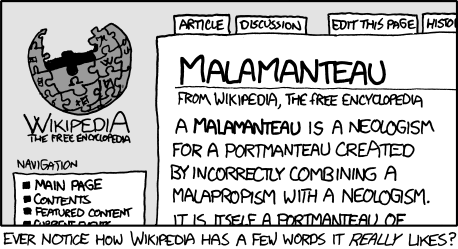
Ironically, Malamanteau was deleted from Wikipedia this morning at...well, actually, the time is debatable.

Now all anyone will ever know about the Malamanteau entry is what Randal Munroe wrote in his comic. That's...kind of sad. And, as someone else from the Grand Rapids area put it, it's ironic that, just as the article gets famous enough to deserve a wikipedia page, it gets its page taken away.
However, to conspiracy theorists who seem to think Wikipedia is going rogue and getting all censorshippy on us, let's please remember Jimmy Wales, and how dedicated he is to the democracy of the internet and not start needlessly boycotting, mkay?
Danke.
Subscribe to:
Posts (Atom)